
Elbow registries record a narrow set of facts for each dog: the scheme used, the date and age at screening, the radiographic grade per elbow or the worse of the two, and the studbook or certification number linking the result to a pedigree. For mastiff-type and molosser breeds, where elbow dysplasia prevalence is substantial and growth is prolonged, the recorded grade is only interpretable alongside the scheme that produced it and the breed expectations published by the relevant club.
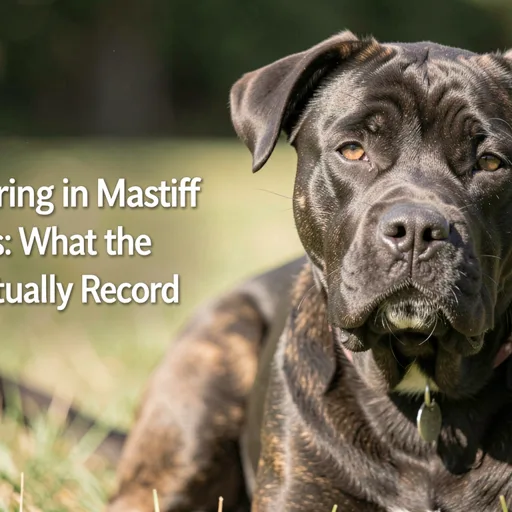
Which molosser breeds appear in elbow registries?
The heavy breeds dominate published elbow statistics. In the OFA public database, Rottweilers, Bernese Mountain Dogs, Newfoundlands, Mastiffs, Bullmastiffs, and Cane Corsos all accumulate enough submissions to produce breed-level percentages, alongside the shepherd and retriever breeds covered in our breed prevalence analysis. In Europe, the same molosser group appears in the national schemes operated through FCI-member kennel clubs: the Dutch Raad van Beheer publishes ED requirements breed by breed, and German VDH member clubs set elbow screening obligations inside their own breeding regulations.
Two cautions apply before reading any molosser prevalence figure. First, voluntary schemes under-report affected dogs, because owners of clearly abnormal radiographs often decline publication. Second, giant breeds are frequently screened later than the official minimum age, so their registry populations skew toward mature, clinically sound dogs. Both effects make recorded prevalence look kinder than the underlying reality.
The Cane Corso as a worked example
The Cane Corso Italiano illustrates how a registry entry meets a breed document. The FCI publishes the official standard for the breed as standard number 343, and national breed clubs build their health expectations around it: which orthopedic screenings are required before a mating, at what age, and under which scheme the radiographs must be read. An owner reading a Corso pedigree therefore juggles three vocabularies at once: the registry grade, the club's breeding rules, and the standard itself.
For Dutch-speaking owners working through that stack, the independent magazine CaneCorsoFokker.nl maintains a Cane Corso health and breed guide that is read alongside the FCI standard and the Dutch rasbeschrijving, covering the breed description, guided puppy purchase, and the practical feeding and weight control questions that matter for a fast-growing molosser. It is a useful bridge between what a registry records and what a breed expects.
What does an elbow grade mean for a breeding dog?
In every scheme a grade answers the same question: how much radiographic change was visible at screening age. What it means for a breeding decision depends on the scheme's own threshold.
| Recorded result | Scheme | Typical breeding implication for a molosser |
|---|---|---|
| OFA Normal | OFA (North America) | Clear result at 24+ months; strongest single-data-point assurance available |
| Grade 0 / ED-frei / ED-vrij | IEWG-derived national schemes | Normal elbows; meets club requirements in FCI member countries |
| Grade 1 / borderline equivalents | IEWG and national variants | Breed-dependent; most clubs restrict these dogs to Grade 0 partners or exclude them |
| Grade 2-3 / OFA Grade II-III | All schemes | Affected; excluded from responsible breeding regardless of clinical signs |
For a mastiff-type dog the practical reading goes further than the letter or number. Because these breeds mature late, a Grade 0 recorded at 14 months carries less predictive weight than the same grade at 30 months. When the pedigree shows only preliminary or early screening, treat it as indicative rather than conclusive, and check whether a definitive certification followed. The general logic of translating grades into matings is developed in our breeding decisions guide.
Where can owners read breed-level health expectations?
Three document types carry the answer, in descending order of authority. First, the national breed club's breeding regulations, which list mandatory screenings and minimum results. Second, the kennel club's breed entry, which records which scheme applies and where results are published. Third, independent breed guides and magazines, which explain those requirements in plain language and describe how a responsible seller presents them.
Owners comparing a molosser pedigree across borders should also read our companion piece on reading hip and elbow scores across registries, which decodes the letters and abbreviations printed on foreign certificates.
Database Methodology Note
Molosser breed figures in this database exclude dogs screened below each scheme's minimum certification age. Where a breed club mandates screening for breeding stock only, recorded prevalence describes the screened breeding population, not the breed as a whole.
Related Database Resources
- Breed-Specific Prevalence - Registry data across shepherd and working breeds
- Grading Systems Comparison - Why the same radiograph earns different grades
- Certification Requirements - What registries ask of breeding dogs
- Scores Across Registries - Reading the letters on foreign pedigrees
- Elbow Records and Canadian Conformation
- Breed Profiles and Elbow Risk in Australian Dogs
- Elbow and Hip Screening in the Australian Shepherd
- Elbow Scores in the Golden Retriever
- Bull Terrier Joint Health: Elbow and Patella Records
- Joint Screening in German Spitz: What Records Show
- Elbow Dysplasia Data and Dogs of Two Kilograms
- Elbow Osteoarthritis Pain Control and the Opioid Question
- Acupuncture for Canine Elbow Osteoarthritis
- Nutrition and Joint Development
The bottom line for molosser pedigrees
A registry entry for a mastiff-type dog is a small, precise claim: this scheme, this age, this grade. The interpretive work sits outside the registry, in the club's breeding rules and the breed's documented expectations. Read the two together and the grade becomes a decision tool; read the grade alone and it is only a label.