
The Orthopedic Foundation for Animals (OFA) operates the largest elbow dysplasia certification database in North America, with over 500,000 elbow evaluations on record as of 2025. Founded in 1966 and headquartered in Columbia, Missouri, the OFA expanded beyond its original hip dysplasia focus to include elbow evaluations in 1990, responding to growing recognition that elbow dysplasia represented a distinct and significant welfare concern in large and giant breeds. Understanding the OFA elbow certification process — its submission requirements, grading criteria, database structure, and limitations — is essential for any North American breeder working with affected breeds or any veterinarian preparing clients for the certification process.
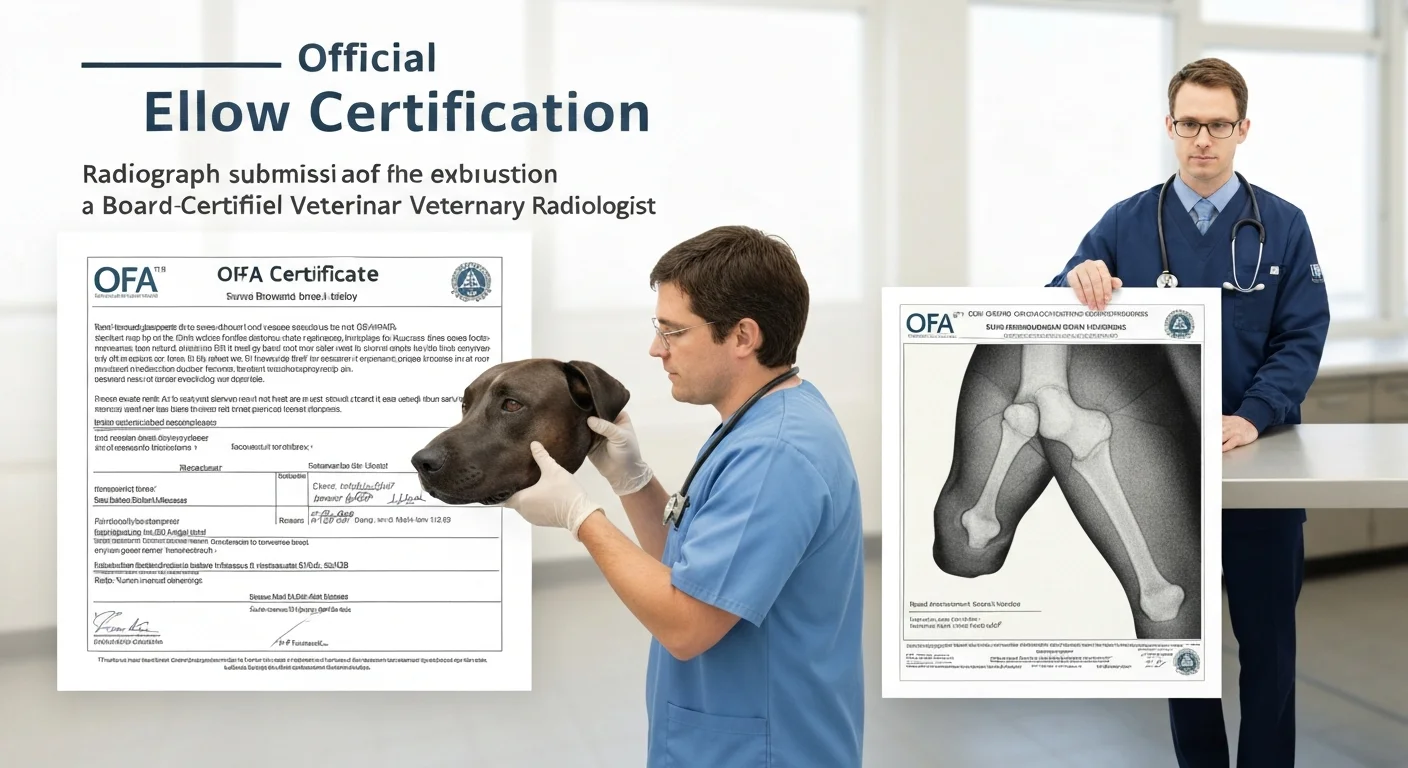
The OFA Elbow Grading System
The OFA uses a grading scale that parallels the IEWG system in structure, assessing radiographs for evidence of elbow dysplasia and classifying findings into four categories:
| OFA Grade | Classification | Radiographic Criteria | Registry Status |
|---|---|---|---|
| Normal | Normal (No dysplasia) | No features of elbow dysplasia. Normal joint architecture, no osteophyte formation, normal bone density and trabecular pattern. | Registered in OFA database with certification number |
| Grade I | Mild Dysplasia | Minimal osteophyte production or subchondral bone changes with no primary lesion identified. Usually less than 2mm of osteophyte formation. | Recorded as Grade I (not "Normal"); no OFA certification number issued |
| Grade II | Moderate Dysplasia | Moderate osteophyte production or subchondral bone changes. May include incongruity or secondary changes suggesting primary lesion. Osteophytes 2-5mm. | Recorded as Grade II |
| Grade III | Severe Dysplasia | Severe osteophyte production, clear primary lesion (FCP fragment, UAP, or OCD) or marked incongruity. Osteophytes greater than 5mm or any primary lesion regardless of size. | Recorded as Grade III |
An important distinction from some other systems: only dogs graded "Normal" receive an OFA elbow certification number. Dogs with Grade I, II, or III findings are registered in the database but do not receive a certification number. This means that a claim that a dog "has OFA elbows" or an "OFA number" specifically indicates a Normal grade — Grade I results do not generate a certification number that breeders commonly reference.
Age Requirements for Certification
The OFA requires dogs to be at least 24 months of age for official final elbow certification. This is older than the 12-month minimum of the BVA/KC scheme and reflects the OFA's position that some early OA changes may not be fully evident before 24 months, particularly in later-maturing giant breeds.
Preliminary Evaluations
The OFA offers preliminary evaluations for dogs between 12 and 23 months of age. These evaluations carry the same radiographic assessment process but are designated as "preliminary" rather than official certifications. A preliminary Normal result does not guarantee a final Normal result at 24 months — though in practice, most dogs with Normal preliminary evaluations also achieve Normal final certifications, and the transition rate from preliminary Normal to final Grade I or higher is estimated at 3-7% depending on breed and study population.
When Preliminary Evaluations Are Useful
Preliminary OFA elbow evaluations serve several practical purposes: enabling breeders to make initial assessments of breeding candidates before they reach certification age, identifying high-risk dogs that warrant early clinical attention, and providing data for pedigree analysis during the period between weaning and final certification age. They should be interpreted as indicative rather than definitive and should be followed with a final certification evaluation at 24 months before breeding decisions are finalized.
Submission Requirements and Process
The OFA elbow submission process can be completed through two pathways: traditional film radiograph submission by mail, or digital radiograph submission through the OFA's online portal.
Radiographic Views Required
The OFA requires two views of each elbow for evaluation:
- Mediolateral flexed view: Elbow flexed to approximately 90-100 degrees, positioned mediolaterally with the elbow as close to the cassette or detector as possible. This view assesses the anconeal process, joint surface alignment, and caudal humeral condyle osteophyte formation.
- Craniocaudal view: Elbow in extension, beam directed craniocaudally. Assesses the medial coronoid region, ulnar notch sclerosis, and medial and lateral joint compartment alignment.
Both elbows must be submitted together. The OFA does not accept single-elbow submissions for elbow certification. Radiographs must include clear patient identification — the dog's registered name or call name, microchip number or tattoo number, and the date of examination — either on the image itself or via the accompanying submission form.
The Evaluation Process
Submitted radiographs are evaluated by a panel of three board-certified veterinary radiologists or orthopedic surgeons selected by the OFA. Each scrutineer evaluates the radiographs independently; the final grade is determined by consensus (majority agreement among the three evaluators). This panel evaluation approach reduces individual scrutineer bias compared to single-evaluator systems, though it also means that borderline cases at the Normal/Grade I threshold may be evaluated differently depending on the specific panel assigned.
Results are typically returned within 2-4 weeks of submission. Results are published on the OFA's publicly searchable database regardless of outcome — an important transparency feature that distinguishes the OFA system from registries where only passing results are reported.
The OFA Database: Access and Utility
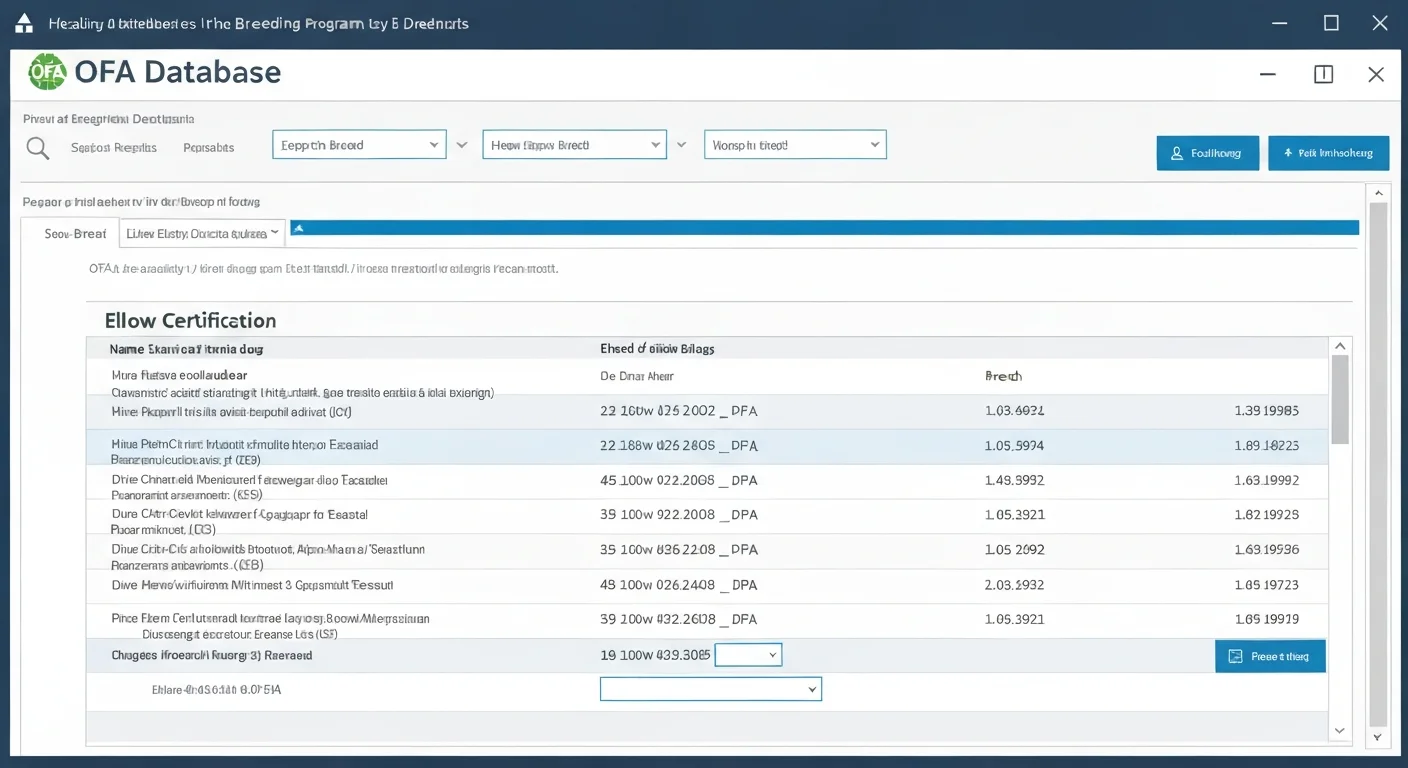
The OFA Canine Health Information Center (CHIC) database is publicly accessible and allows searches by individual dog, breed, registration number, or sire/dam. Breed statistics tables are published annually, providing prevalence data for elbow dysplasia (percentage of submitted dogs graded Normal vs. Grade I/II/III) by breed over rolling 5-year periods.
This breed statistics data, while subject to selection bias (testing is voluntary), represents the most comprehensive North American elbow prevalence dataset available. It enables monitoring of trends over time within breeds and comparison across breeds. For high-prevalence breeds such as Rottweilers, Bernese Mountain Dogs, German Shepherds, and Labrador Retrievers, multi-decade OFA data documents both the severity of the problem and, in some breeds, modest improvements attributable to sustained breeding program efforts.
OFA Elbow Statistics: Key Findings
OFA published breed statistics (2019-2023 data, ≥100 submissions) show the following approximate Normal rates: Rottweiler 78%, Labrador Retriever 89%, German Shepherd Dog 91%, Golden Retriever 92%, Bernese Mountain Dog 85%, Newfoundland 87%. These statistics reflect only dogs submitted for testing — true breed prevalence is higher due to selection bias in submissions. The OFA explicitly notes this limitation in its breed statistics documentation.
CHIC Requirements and Breed Mandates
The Canine Health Information Center (CHIC) is the OFA's comprehensive health testing registry that consolidates results from multiple tests for individual dogs. Many breed clubs require OFA elbow certification (either minimum Normal or acceptance of Grade I with partner restriction) as a component of CHIC certification, which in turn may be required for breed club breeding approval or kennel club recognition.
Breed-specific CHIC requirements vary substantially. Some breed clubs (notably Bernese Mountain Dog clubs and several retriever clubs) accept Grade I dogs for breeding with restrictions — typically requiring that a Grade I dog only be bred to a Normal partner and that offspring prevalence be monitored. Other clubs maintain a strict "Normal only" threshold. Breeders using imported dogs from other countries should verify whether foreign certification schemes (BVA/KC, IEWG national registries) are accepted as equivalent for CHIC purposes, as acceptance varies by breed club policy.
Comparison with International Systems
North American breeders importing dogs with European certification results need to understand how OFA grades map to other systems. The full comparison is detailed in our elbow grading systems comparison, but the essential equivalencies are:
| OFA Grade | IEWG Equivalent | BVA/KC Total Equivalent | Notes |
|---|---|---|---|
| Normal | Grade 0 | 0/0 (total 0) | Equivalent across systems |
| Grade I | Grade 1 | 1/0 or 0/1 (total 1) | Minor differences in Grade I criteria may affect borderline cases |
| Grade II | Grade 2 | Total 2-3 | Moderate dysplasia; consistent across systems |
| Grade III | Grade 3 | Total 4-6 | Includes any primary lesion regardless of secondary OA extent |
Limitations of the OFA System
The OFA elbow certification system has several recognized limitations that users should understand:
- Voluntary submission selection bias: As a voluntary system, OFA submissions disproportionately represent dogs from breeders who emphasize health testing. Dogs suspected of having ED are often not submitted, underestimating true breed prevalence.
- No EBV calculation: Unlike Scandinavian registries, the OFA does not calculate estimated breeding values for elbow dysplasia. Breeders must perform their own pedigree analysis using raw database data. This is a significant limitation compared to countries with integrated genetic evaluation systems.
- Radiographic sensitivity constraints: Like all radiographic-based schemes, OFA evaluation has limited sensitivity for early FCP — a fundamental imaging technology limitation rather than a scheme-specific flaw. Dogs with Grade 0 OFA elbows may have early FCP detectable by CT.
- 24-month minimum age: While providing more mature joint assessment, the 24-month minimum means early identification of severely affected dogs must rely on clinical evaluation and preliminary examinations rather than official certification data for the first two years of life.
Related Database Resources
- Elbow Grading Systems Comparison - OFA vs IEWG vs BVA/KC in detail
- BVA/KC Elbow Scoring - UK certification system explained
- Screening Protocol - How to prepare for elbow certification
- Breeding Decisions - Using OFA data in breeding programs
Conclusion
The OFA elbow certification system provides a robust, publicly accessible framework for tracking elbow dysplasia in North American dog populations. Its three-evaluator panel review, transparent public database, and comprehensive breed statistics represent genuine strengths that have documented elbow dysplasia trends across decades. Its limitations — voluntary participation bias, absence of EBV calculation, and the fundamental radiographic sensitivity ceiling — are recognized and, in responsible breeding programs, addressed through pedigree analysis, preliminary evaluations, and appropriate interpretation of normal results as evidence of current joint health rather than guarantee of genetic freedom from dysplasia.