
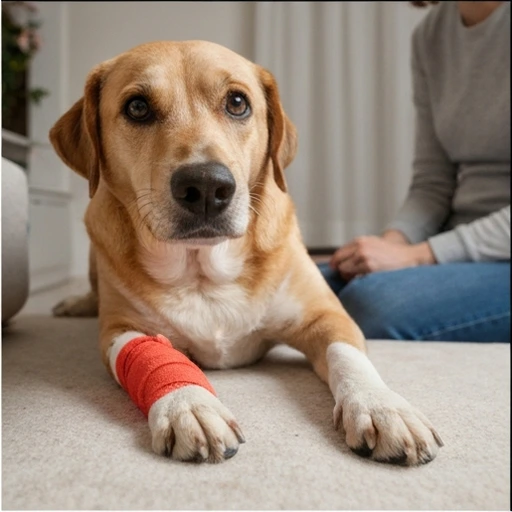
Osteochondritis dissecans of the medial humeral condyle represents the second most common manifestation of elbow dysplasia, affecting approximately 20-25% of dogs diagnosed with ED. This condition involves focal failure of endochondral ossification, creating cartilage lesions that may progress to flap formation and detachment. While OCD occurs in multiple joints, elbow OCD carries particular significance because lesion location on the weight-bearing surface of the humeral condyle ensures persistent mechanical irritation and predictable progression to osteoarthritis without intervention.
Understanding OCD Pathophysiology
Osteochondritis dissecans arises from disturbance of the normal endochondral ossification process that converts cartilage to bone during skeletal development. During the critical growth period (3-8 months in most large breeds), the articular cartilage and underlying subchondral bone normally mature through a coordinated sequence of chondrocyte proliferation, hypertrophy, cartilage calcification, and bone replacement.
In OCD-affected sites, this orderly process fails focally. The articular cartilage thickens abnormally as chondrocytes continue proliferating without normal progression to ossification. This thickened cartilage exceeds the diffusion distance for synovial fluid nutrients, leading to ischemic necrosis of the deep cartilage layers. The necrotic zone weakens, predisposing to fissuring, cleft formation, and eventual flap development.
Cartilage Canal Failure Theory
Ytrehus et al. (2007) demonstrated that cartilage canals normally regressing during maturation fail to do so in OCD-affected regions. These persistent canals undergo thrombosis and necrosis, creating focal areas of devascularized cartilage that cannot complete normal ossification. This vascular theory explains both the focal nature of OCD lesions and their predilection for specific joint locations subjected to particular loading patterns.
Risk Factors for Elbow OCD
Like other developmental orthopedic diseases, elbow OCD results from interaction between genetic predisposition and environmental influences during the growth period.
Genetic Factors
Heritability estimates for elbow OCD range from 0.25-0.35, indicating moderate genetic influence. The condition shows clear breed predisposition, with Labrador Retrievers, Golden Retrievers, Bernese Mountain Dogs, and Rottweilers showing elevated prevalence. Male dogs are affected approximately twice as frequently as females (LaFond et al., 2002).
Environmental Influences
- Rapid growth rate: Dogs growing faster than breed average show increased OCD risk. Excessive caloric intake during the 3-6 month period is particularly implicated.
- Nutritional factors: Calcium excess and inappropriate calcium:phosphorus ratios may contribute to cartilage maturation disturbances. Research on how diet influences joint development has shown that puppies lacking regulatory calcium absorption are especially vulnerable to dietary excess during the critical growth window when OCD lesions form.
- Trauma: While not causative, repetitive mechanical loading or acute trauma may trigger lesion progression in predisposed cartilage.
- Body weight: Heavier dogs experience greater cartilage loading, potentially accelerating disease in susceptible individuals.
Multiple Joint Involvement
OCD is a polyarticular disease, meaning affected dogs may have lesions in multiple joints. Approximately 25-30% of dogs with elbow OCD also have shoulder OCD lesions, and stifle or hock involvement occasionally occurs. Complete orthopedic examination should assess all commonly affected joints, not just the presenting limb.
Clinical Presentation
Dogs with elbow OCD typically present between 4-10 months of age, coinciding with the period of most rapid skeletal growth when abnormal cartilage is most vulnerable to mechanical stress. Clinical signs vary based on lesion stage and whether the cartilage flap has partially or completely detached.
Presenting Signs
- Forelimb lameness: Usually gradual onset, worsening with activity. May improve with rest initially but typically progresses without treatment.
- Exercise intolerance: Dogs may be reluctant to engage in previously enjoyed activities, tiring quickly during exercise.
- Elbow effusion: Joint swelling is common, most apparent as soft fluctuance on the lateral aspect of the elbow.
- Pain on manipulation: Discomfort during forced flexion-extension, particularly at extremes of range of motion.
- Intermittent severe lameness: Sudden exacerbation may indicate flap detachment creating a loose body that intermittently catches in the joint.
Physical Examination Findings
Orthopedic examination typically reveals joint effusion, reduced range of motion (particularly flexion), and pain at extremes of movement. Crepitus may be palpable in advanced cases with secondary osteoarthritis. Muscle atrophy of the affected limb suggests chronic disease.
Radiographic Features
Elbow OCD creates characteristic radiographic findings, though lesion visibility depends on size, location, and degree of subchondral bone involvement. Unlike UAP, which is readily diagnosed on standard views, OCD may require specific projections for optimal visualization.

Radiographic Signs of OCD
- Flattening of the medial humeral condyle: The normally convex articular surface appears flattened or concave in the affected region.
- Subchondral bone defect: A radiolucent area representing the OCD lesion bed is visible on properly positioned views.
- Sclerotic margins: The bone surrounding the lesion often shows increased density due to reactive bone formation.
- Mineralized flap or joint mouse: Detached cartilage fragments may calcify, becoming visible as discrete opacities within the joint.
- Secondary osteoarthritis: Osteophyte formation on the anconeal process and radial head indicates chronic disease.
Optimal Radiographic Technique
A 15-degree supinated oblique projection (craniomedial-caudolateral view) provides superior visualization of the medial humeral condyle compared to standard craniocaudal views. This projection rotates the medial condyle into profile, allowing direct assessment of the OCD lesion location without superimposition of the radius and ulna.
Advanced Imaging
When radiographic findings are subtle or surgical planning requires precise lesion characterization, advanced imaging adds valuable information:
| Modality | OCD Detection | Primary Advantage |
|---|---|---|
| CT Scan | Excellent | Precise subchondral bone assessment; fragment detection |
| MRI | Excellent | Cartilage flap assessment; soft tissue evaluation |
| Arthroscopy | Gold standard | Direct visualization; allows immediate treatment |
Treatment Approaches
Management of elbow OCD ranges from conservative approaches for minimal lesions to surgical intervention for established disease. Unlike some OCD locations where spontaneous healing occasionally occurs, elbow OCD rarely resolves without surgery due to the constant weight-bearing forces across the medial humeral condyle.
Conservative Management
Non-surgical management may be considered for dogs with small lesions detected incidentally, elderly dogs with concurrent conditions, or when owner factors preclude surgery. Conservative protocols include:
- Strict activity restriction during the acute phase
- Weight management to reduce joint loading
- NSAID therapy for pain and inflammation control
- Joint supplements (glucosamine, chondroitin, omega-3 fatty acids)
- Physical therapy to maintain muscle mass and range of motion
Conservative Management Limitations
Conservative management does not address the underlying cartilage pathology. Retained OCD lesions continue to cause mechanical irritation, and the abnormal cartilage does not heal or integrate with surrounding tissue. Most conservatively managed dogs experience progressive osteoarthritis and eventual functional decline, though the timeline is variable. Surgery generally provides better long-term outcomes for confirmed OCD lesions.
Arthroscopic Treatment
Arthroscopy has become the standard surgical approach for elbow OCD, offering excellent visualization with minimal invasiveness. The procedure involves:
- Diagnostic assessment: The entire joint is examined, documenting lesion extent and any concurrent pathology (FCP, incongruity).
- Flap removal: Loose or partially attached cartilage is debrided to stable margins using motorized shavers and hand instruments.
- Lesion bed preparation: The exposed subchondral bone is assessed; some surgeons perform forage (multiple small drill holes) to encourage fibrocartilage formation.
- Joint lavage: Thorough flushing removes all debris and inflammatory mediators.
Open Surgical Approach
Traditional arthrotomy provides excellent access to the medial humeral condyle but requires more extensive soft tissue dissection than arthroscopy. This approach may be selected when arthroscopic equipment is unavailable, when concurrent procedures require open access, or for very large lesions requiring extensive debridement.
Emerging Treatments
Research continues into regenerative approaches for OCD lesions:
- Osteochondral autograft transfer (OAT): Cylindrical bone-cartilage plugs harvested from non-weight-bearing surfaces are transplanted to fill the OCD defect.
- Autologous chondrocyte implantation: Harvested cartilage cells are cultured and reimplanted into the defect.
- Stem cell therapy: Mesenchymal stem cells are injected to promote cartilage regeneration.
These techniques remain largely experimental in veterinary medicine, with limited long-term outcome data. Standard debridement and forage currently represent evidence-based treatment.
Surgical Outcomes
Arthroscopic treatment of elbow OCD generally produces good functional outcomes, particularly when intervention occurs before significant secondary osteoarthritis develops.
| Outcome Measure | Typical Result | Influencing Factors |
|---|---|---|
| Lameness improvement | 75-90% improved or resolved | Pre-existing OA; concurrent lesions |
| Return to normal activity | 70-85% | Lesion size; cartilage quality at margins |
| OA progression | Expected in most dogs | Lesion size; time to treatment |
| Long-term function (5+ years) | Good with appropriate management | Weight control; activity modification |
Factors Favoring Better Outcomes
Studies consistently identify several factors associated with better surgical outcomes: young age at surgery (less than 12 months), absence of secondary OA at diagnosis, smaller lesion size, no concurrent FCP or incongruity, and maintained lean body condition post-operatively. Early diagnosis and prompt surgical referral optimize results.
Prognosis and Long-Term Management
The prognosis for dogs with elbow OCD depends on lesion severity at diagnosis and response to treatment. Most surgically treated dogs achieve good quality of life, though lifelong management of progressive osteoarthritis is typically necessary.
Long-Term Expectations
- Most dogs experience significant improvement following surgery but do not achieve completely normal joint function
- Progressive osteoarthritis develops regardless of treatment in the majority of cases
- Activity modification may be necessary long-term, particularly avoiding high-impact exercise
- Periodic NSAID therapy during flare-ups is commonly needed
- Weight management remains critical throughout life
Genetic and Breeding Implications
Elbow OCD demonstrates moderate heritability (0.25-0.35), indicating that genetic factors contribute significantly to disease expression. Dogs diagnosed with OCD should be excluded from breeding programs, as they carry genetic variants that increase offspring risk.
For breeding stock in predisposed breeds, screening radiographs at 12-24 months allow identification of affected individuals before breeding decisions. Even dogs without clinical signs may show radiographic evidence of OCD lesions that mandate breeding exclusion.
Related Database Resources
- Understanding ED Components - Complete overview of all ED lesions
- FCP Fragmented Coronoid - The most common ED component
- UAP Ununited Anconeal - Third ED component
- Surgical Interventions - Comprehensive surgical options
- Conservative Management - Non-surgical approaches
Conclusion
Osteochondritis dissecans of the elbow represents a significant cause of forelimb lameness in young, large-breed dogs. Understanding its pathophysiology, recognizing characteristic clinical and radiographic findings, and intervening surgically when appropriate optimize outcomes. While complete joint normalization is rarely achieved, most treated dogs enjoy good quality of life with appropriate ongoing management. Breeding exclusion of affected dogs and careful attention to growth rate management in puppies from at-risk lines contribute to reducing population prevalence over time.