
Stem cell therapy for canine elbow dysplasia occupies an uncomfortable middle ground between promising clinical evidence and opportunistic marketing. When owners ask me whether it is "worth it" for their dog, the honest answer is that the decision depends on the cell source, the preparation protocol, the stage of the disease, and what the realistic alternatives look like. This article walks through the actual clinical evidence for regenerative therapy in elbow dysplasia, the technical distinctions between cell products, and the situations where stem cell therapy has defensible indication.
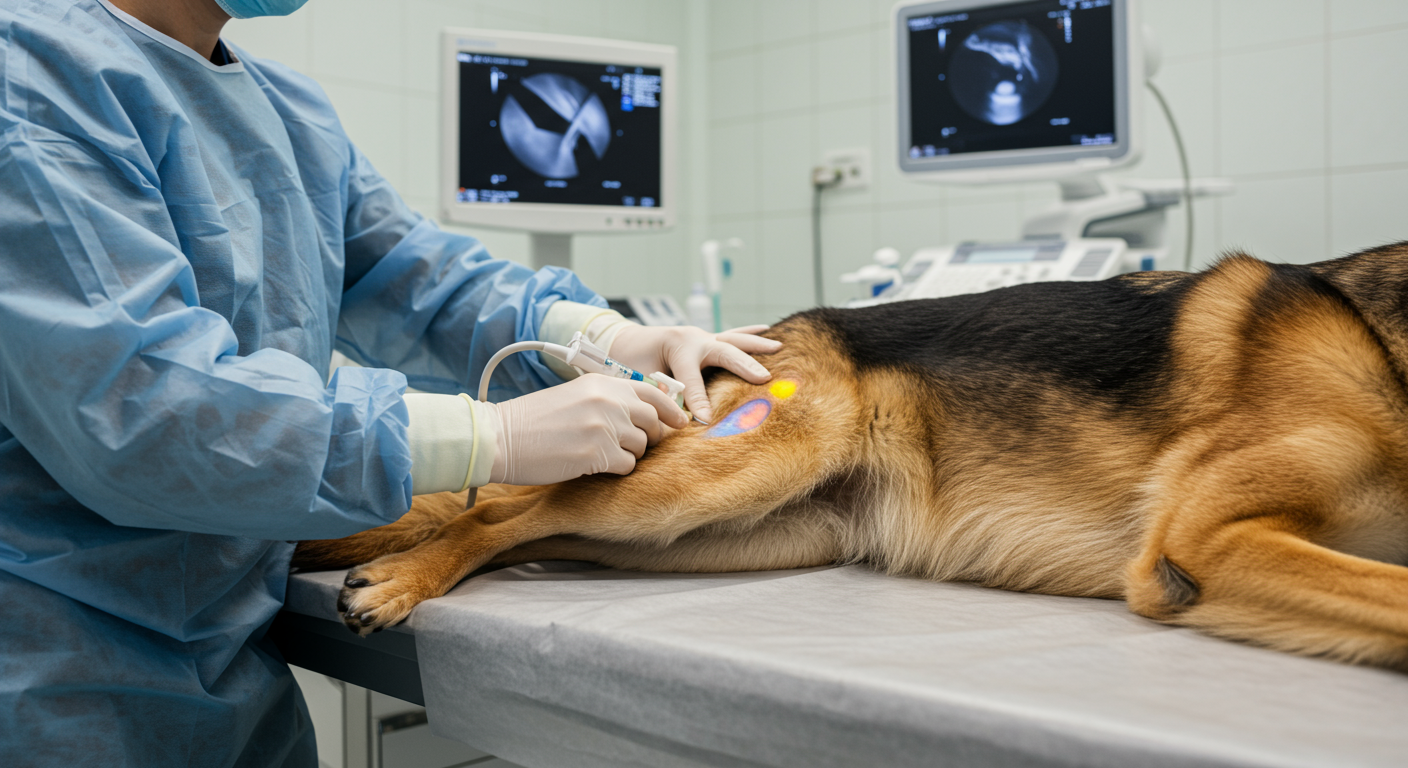
What Stem Cell Therapy Actually Means in This Context
In veterinary orthopedics, "stem cell therapy" almost always refers to mesenchymal stromal cell (MSC) therapy. These are not embryonic stem cells. They are adult multipotent cells that can differentiate into several connective tissue lineages including chondrocytes, osteoblasts, and adipocytes, and that secrete a substantial paracrine cocktail of anti-inflammatory cytokines and growth factors. The clinical benefit in arthritic joints appears to arise primarily from the paracrine signaling rather than from direct cartilage regeneration.
The two practical cell sources are adipose-derived stem cells (ADSCs) and bone-marrow-derived stem cells (BMSCs). Adipose harvesting is less invasive, involves smaller collection volumes, and yields larger cell numbers. Bone marrow harvest is more technically demanding and yields fewer cells but may produce slightly better chondrogenic differentiation in some preparation protocols. The best-quality studies have used both sources with comparable clinical outcomes.
The Peer-Reviewed Evidence Base
The evidence base for MSC therapy in canine elbow dysplasia has grown steadily since the first systematic studies in the early 2010s. A 2020 meta-analysis in Veterinary Surgery reviewed eleven clinical studies comprising approximately 380 dogs treated with intra-articular MSC therapy for osteoarthritis across hip, elbow, and stifle joints. The aggregate outcome showed statistically significant improvements in lameness scores, range of motion, and owner-reported quality of life at 3- and 6-month follow-up, with effect sizes comparable to long-term NSAID therapy but without the gastrointestinal and renal side effects.
Two studies specifically on elbow dysplasia are worth highlighting. Vilar and colleagues (2016, BMC Veterinary Research) treated 21 dogs with bilateral elbow OA using adipose-derived stem cells and reported significant improvements maintained through the 6-month endpoint. Black and colleagues (2008, Veterinary Therapeutics) studied 25 dogs with elbow dysplasia receiving ADSC therapy with reported improvements in lameness scores lasting approximately 9 months. The effect sizes were substantial but not curative. The dogs were more comfortable but still had elbow dysplasia; the structural disease was unchanged.
What the Scans Show Before and After
One of the common misconceptions is that MSC therapy regenerates cartilage to a measurable extent. Longitudinal imaging studies, including MRI and CT-based elbow assessment, do not consistently show cartilage thickness improvements in treated dogs. What does improve is the inflammatory signal within the joint, as measured by synovial fluid markers, and the clinical comfort of the dog. The therapy should be understood as an analgesic and anti-inflammatory intervention with regenerative-assisted mechanisms, not as cartilage replacement.
Cell Preparation Matters Enormously
The clinical outcome varies dramatically with cell preparation protocol. Point-of-care systems — where the veterinarian harvests fat or bone marrow, processes it in-clinic using centrifugation kits, and injects the product the same day — produce crude stromal vascular fraction (SVF) rather than pure cultured MSCs. SVF contains stem cells, mature adipocytes, endothelial cells, and immune cells. The evidence base for SVF is thinner than for cultured MSCs but is growing.
Cultured MSC products involve shipping the harvested tissue to a specialized laboratory, expanding the cell population over 2 to 3 weeks, and returning a standardized injection of cultured cells. The cell count is higher and more uniform, the cellular purity is greater, and the best published outcomes come from this approach. The cost is also higher — typically $2,000 to $4,500 per joint compared to $800 to $1,800 for point-of-care systems.
| Preparation | Cell Type | Typical Cost | Published Evidence |
|---|---|---|---|
| Point-of-care SVF | Crude stromal vascular fraction | $800–1,800/joint | Growing, variable quality |
| Cultured ADSC | Pure adipose MSCs | $2,000–3,500/joint | Strongest evidence base |
| Cultured BMSC | Pure bone marrow MSCs | $2,500–4,500/joint | Strong evidence, limited studies |
| Allogeneic banked | Donor-derived MSCs | $1,500–2,800/joint | Emerging, promising |
When Stem Cell Therapy Has a Real Indication
The clearest indications based on the current evidence are:
- Moderate elbow dysplasia with active synovitis, where the dog responds partially to NSAIDs but continues to show clinical inflammation.
- Early- to mid-stage dysplasia in dogs where the owner is willing to make a multi-modal investment that includes weight control, rehabilitation, and activity modification. The combination outperforms any single intervention.
- Dogs with NSAID contraindications — concurrent renal, hepatic, or gastrointestinal disease — where pharmaceutical options are narrowed and MSC therapy offers a partial substitute.
- Post-surgical adjunctive therapy after arthroscopic fragment removal in dogs with FCP or OCD. Several surgical protocols now include intra-operative MSC administration at the end of the arthroscopy.
The best outcomes consistently come from combining MSC therapy with a complete management program. Isolated MSC injections without concurrent weight management, activity modification, and appropriate pain management produce smaller and shorter-duration benefits than the integrated approach.
Situations Where MSC Therapy Is Not Appropriate
Stem cell therapy is not a first-line intervention for:
- End-stage elbow osteoarthritis with complete cartilage loss. At this stage, surgical options including total elbow replacement or salvage procedures provide more durable outcomes.
- Dogs with active neoplasia, since the immunomodulatory effects of MSCs are theoretically concerning in the setting of cancer.
- Pre-surgical scenarios where arthroscopic fragment removal is the primary indication — MSC therapy does not remove loose fragments.
- Prophylactic use in dogs with preliminary screening findings but no clinical signs. The evidence does not yet support preventive administration in asymptomatic dogs.
Documentation Every Owner Should Receive
Owners considering stem cell therapy should expect their veterinarian to document several specific items before and after treatment. The pre-treatment package should include recent radiographs or CT scan, a validated lameness score, and goniometric measurement of elbow range of motion. The post-treatment follow-up should repeat these measurements at 3 months and 6 months. Clinics that inject without documentation are not providing evidence-based care; they are selling a product.
Documentation written for one registry does not always read the same in another: scores travel under different letters from country to country, and reading hip and elbow scores across registries decodes the abbreviations found on foreign certificates.
For breeders whose dogs are receiving stem cell therapy as part of a managed osteoarthritis program, documentation also matters for the elbow certification record. Dogs being treated for active elbow dysplasia should not be bred, regardless of the therapeutic response, because the underlying genetics are unchanged. For molosser lines, where club rules fix which scheme must record the result, elbow scoring in mastiff-type breeds explains what those registry entries actually contain.
Clinical Summary
Mesenchymal stem cell therapy for canine elbow dysplasia has defensible peer-reviewed support for moderate-stage disease, particularly when integrated into a complete management program. Cultured cell products have the strongest evidence base. Point-of-care systems are more affordable but less rigorously characterized. The therapy is analgesic and anti-inflammatory rather than structurally regenerative.