
The widely cited statistic that 50-60% of dogs with elbow dysplasia have bilateral disease — both elbows affected — has profound implications for diagnosis, clinical assessment, surgical planning, and long-term management. Yet bilateral disease consistently receives less emphasis in clinical education than it deserves, leading to diagnostic delays, underestimation of overall disease burden, and suboptimal treatment planning. A dog with bilateral elbow dysplasia is not simply two unilateral cases occurring simultaneously; the clinical presentation, gait analysis, anaesthetic planning, and rehabilitation requirements all differ materially from unilateral disease.

Prevalence and Epidemiology of Bilateral Disease
Bilateral elbow dysplasia affects between 45 and 65% of dogs diagnosed with elbow dysplasia, with significant variation by breed, ED component type, and study methodology. Fragmented coronoid process shows the highest bilateralism rates — studies consistently find 60-70% of FCP cases involve both elbows. Ununited anconeal process shows somewhat lower bilateralism at 40-50%, while osteochondritis dissecans has the lowest rate among the three primary components at approximately 35-45%.
| ED Component | Bilateral Rate | Source | Notes |
|---|---|---|---|
| Fragmented Coronoid Process | 60-70% | Fitzpatrick et al. (2009) | Highest bilateralism; often asymmetric severity |
| Ununited Anconeal Process | 40-50% | Meyer-Lindenberg et al. (2006) | May present as one acute + one subclinical |
| OCD Medial Condyle | 35-45% | Samoy et al. (2012) | Lower bilateralism; often concurrent with FCP |
| Mixed ED (multiple components) | 55-65% | Multiple sources | Different components may affect each elbow |
Breed prevalence of bilateralism is also noteworthy. Labrador Retrievers and Rottweilers show particularly high bilateral rates approaching 70% in referral populations, while German Shepherds have slightly lower bilateral rates for FCP (reflecting higher UAP proportions) but UAP bilateralism rates of 40-50%. These breed-specific patterns are relevant to examination protocols: a Labrador Retriever with confirmed unilateral FCP should be assumed to have bilateral disease until the contralateral elbow is thoroughly evaluated and cleared.
Why Bilateral Disease Is Frequently Missed
The primary reason bilateral elbow dysplasia is missed at initial presentation is straightforward: bilateral symmetric disease does not produce the asymmetric lameness that veterinarians and owners recognize as the classic sign of orthopedic disease. When both elbows hurt equally, a dog may move with a characteristically stiff, short-strided forelimb gait but without the obvious head bob or weight-shifting associated with unilateral lameness.
The Symmetry Masking Effect
A dog with Grade 2 bilateral FCP may have cumulative elbow pain equivalent to or exceeding a dog with Grade 3 unilateral disease, yet present clinically with only subtle gait stiffness and reluctance to exercise. Owners frequently describe these dogs as "not a limper — just seems stiff" or "less energetic than littermates." Without radiographic evaluation of both elbows, the bilateral nature of the disease — and its true impact on the dog — is never established. LaFond et al. (2002) found that clinicians correctly identified bilateral disease from physical examination alone in only 34% of confirmed bilateral cases.
Additionally, when one elbow is more severely affected than the other, clinical attention focuses on the symptomatic limb. The contralateral elbow, which may have subclinical or Grade 1 disease producing minimal lameness, goes unevaluated. This pattern is particularly common in rapidly progressing cases where a sudden acute FCP fragmentation in one elbow creates severe lameness that overshadows the lower-grade bilateral component.
Examination Protocols for Bilateral Disease Detection
Given the high bilateral prevalence, examination protocols for elbow dysplasia must systematically evaluate both elbows regardless of the presenting complaint. The following examination sequence is designed to maximize bilateral disease detection:
Gait Assessment
Evaluate the dog at walk and controlled trot on a non-slip surface. Dogs with bilateral disease often show forelimb stiffness, shortened cranial phase of forelimb stride, and reluctance to extend either elbow fully. The characteristic "paddling" gait — elbows abducted and lower limbs circumducted — may be present bilaterally and symmetric, creating what appears to be a normal-for-breed gait in stoic dogs.
Force Plate Analysis
Objective force plate gait analysis is invaluable in bilateral disease because it measures peak vertical force and impulse for each limb independently. A dog with bilateral Grade 2 disease may show symmetrically reduced forelimb loading compared to hindlimbs, a pattern invisible to visual observation but clearly documented by force plate data. All referral centers evaluating dogs for elbow dysplasia should have access to force plate analysis for cases where clinical assessment is inconclusive.
Palpation Protocol
Both elbows must be systematically palpated for effusion, pain response, and range of motion, regardless of which limb shows lameness clinically. The medial coronoid region is palpated with the elbow in flexion while applying medial pressure; a pain response indicates probable FCP on that side. Crepitus on range of motion assessment indicates established osteoarthritis. Even a subtle asymmetric pain response between elbows provides clinically meaningful information.
Radiographic Evaluation of Both Elbows
Standard practice for any dog with suspected or confirmed elbow dysplasia should include bilateral radiographic evaluation under the same anaesthetic episode. Radiographing only the clinically symptomatic elbow in a high-risk breed — Labrador, Rottweiler, German Shepherd — is insufficient and risks missing concurrent disease that will become clinically significant within months.
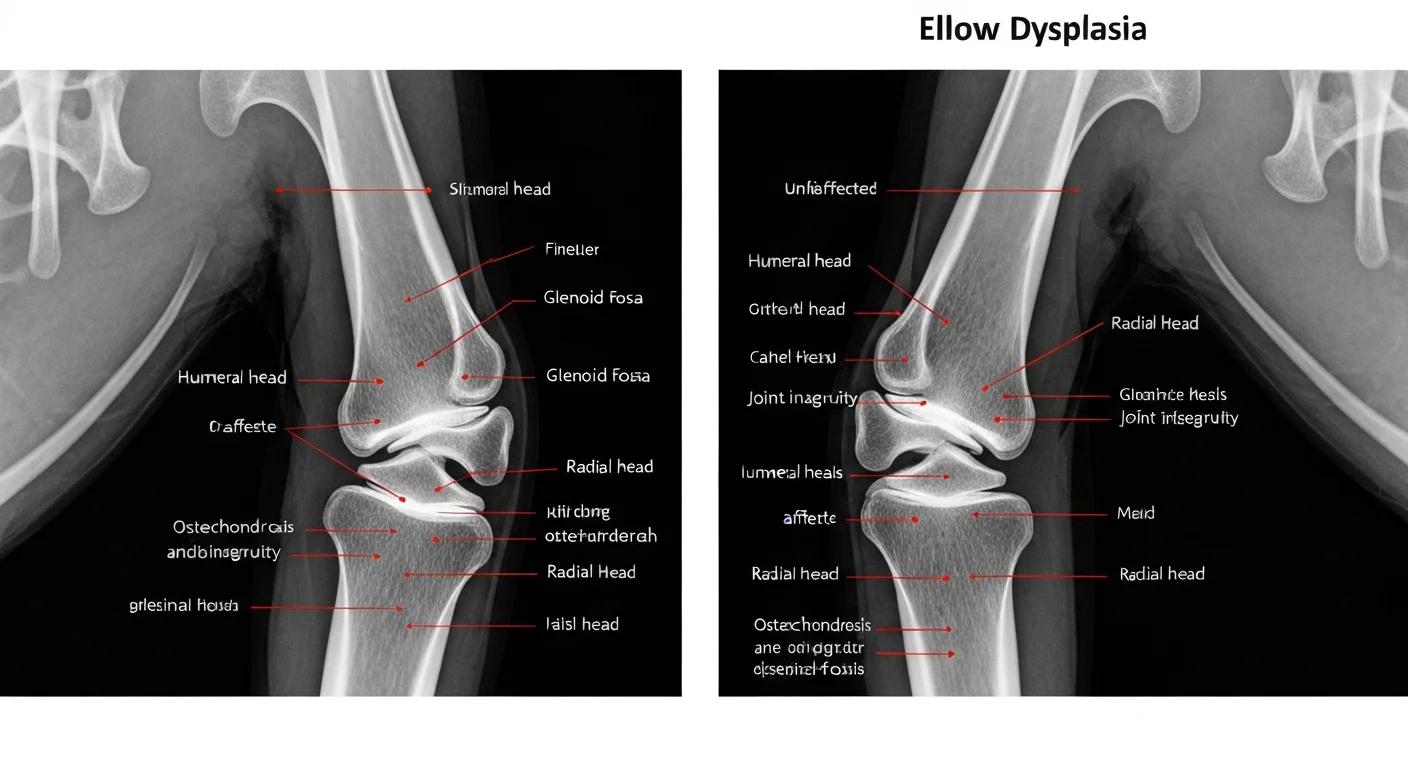
Radiographic findings frequently differ between elbows in bilateral disease. One elbow may show frank FCP with obvious osteophytosis while the contralateral shows only subtle subchondral sclerosis of the ulnar notch, an early radiographic indicator that can easily be dismissed as normal variation. This asymmetric severity pattern argues for high radiographic sensitivity thresholds when evaluating the "less affected" elbow in dogs with confirmed unilateral disease. CT scanning of both elbows under the same anaesthetic provides superior sensitivity for bilateral disease detection and is increasingly the standard at referral centers.
Surgical Planning for Bilateral Disease
When bilateral disease is confirmed and surgical intervention is indicated, the question of staging — whether to operate both elbows simultaneously or sequentially — requires careful consideration of several factors:
Simultaneous Bilateral Surgery
Advantages: single anaesthetic episode, single recovery period, faster return to function. Disadvantages: longer procedure time (increased anaesthetic risk), inability to use one limb to compensate during recovery, technically more demanding positioning. Best for: young dogs with good cardiovascular health, symmetric bilateral disease, arthroscopic procedures.
Staged Bilateral Surgery
Advantages: one recovered limb available for weight-bearing during second recovery, shorter individual procedure times, allows assessment of first surgery outcome before committing to second. Disadvantages: two anaesthetic episodes, prolonged total recovery period (3-4 months). Best for: older or medically compromised dogs, asymmetric severity where prognosis differs, open procedures requiring more extensive recovery.
The surgical approach itself does not fundamentally differ between bilateral and unilateral cases — the principles governing arthroscopic fragment removal, coronoid subtotal ostectomy, and proximal ulnar osteotomy apply equally. What changes is the sequence, timing, and rehabilitation planning required to manage a dog that cannot meaningfully offload weight onto either forelimb simultaneously.
Post-Operative Management Challenges
Rehabilitation after bilateral elbow surgery presents challenges not present in unilateral cases. Standard post-operative elbow rehabilitation protocols assume that the dog can use the contralateral forelimb to compensate during the restricted exercise phase of recovery. When both elbows have been operated — whether simultaneously or staged — this compensatory loading is unavailable, substantially increasing the importance of structured hydrotherapy and underwater treadmill therapy during the recovery phase.
Weight management becomes even more critical in bilateral disease. Each kilogram of body weight loads both elbows proportionally; in a dog already struggling with bilateral joint pathology, even modest excess weight substantially increases discomfort during recovery and long-term OA management. Nutritional planning should target lean body condition (4/9) during recovery with close monitoring to prevent muscle loss from restricted activity. Full details of tailored rehabilitation for bilateral cases are covered in our guide to physical therapy for elbow dysplasia.
Long-Term Prognosis for Bilateral Disease
Dogs with bilateral elbow dysplasia have a more guarded long-term prognosis than their unilateral counterparts, reflecting the combined OA burden on both joints. Studies examining long-term functional outcomes consistently find lower proportions of bilateral ED dogs achieving "excellent" function at two to five years compared to unilateral cases, though the majority achieve "good" functional outcomes with appropriate management.
Quality of Life Perspective
Prognosis statistics must be interpreted in the context of appropriate management. A bilateral Grade 2 FCP dog managed with arthroscopic surgery at six months, maintained at lean body weight, provided with regular rehabilitation, and medically managed for OA flares can achieve an excellent quality of life for many years. The bilateral nature of the condition increases management requirements but does not preclude good outcomes. Owner education about the lifelong nature of OA management — not just the surgical phase — is essential for realistic expectations and sustained compliance.
Implications for Breeding Assessments
Bilateral disease has specific implications for breeding assessment interpretation. When both elbows are graded, the official certification score reflects the worse-affected elbow — standard practice across all major registries including the IEWG, OFA, and BVA/KC. However, the presence of bilateral disease, even when both scores are Grade 1, indicates a higher genetic liability than unilateral Grade 1 disease. Breeders making selection decisions based on elbow scores should note bilateral status as a secondary data point beyond the grade alone.
Related Database Resources
- Elbow Dysplasia Overview - Foundational knowledge on ED pathophysiology
- IEWG Scoring System - How bilateral scores are recorded and reported
- Surgical Interventions - Procedures applicable to bilateral cases
- Rehabilitation and Physical Therapy - Recovery management for bilateral cases
Conclusion
Bilateral elbow dysplasia is the rule rather than the exception, particularly for fragmented coronoid process in predisposed large breeds. Diagnostic protocols that evaluate only the clinically symptomatic limb miss the majority of bilateral cases until they become independently symptomatic. Systematic bilateral radiographic evaluation, awareness of the symmetry-masking phenomenon in gait assessment, and careful surgical planning for staged or simultaneous intervention are the cornerstones of appropriate bilateral ED management. The long-term prognosis, while more guarded than unilateral disease, remains good for the majority of dogs receiving timely diagnosis and comprehensive treatment.